AI Hotel Revenue Management Software: Maximise RevPAR Automatically
VARO analyses demand patterns, competitor rates, and booking pace to recommend the right price for every room, every day so your revenue grows without manual monitoring.
Understanding Modern Yield Optimization for Hotels
Hotel revenue management is the practice of selling the right room, to the right guest, at the right price, at the right time. For decades, hoteliers relied on fixed seasonal calendars, manually shifting from peak to off-peak pricing based on gut feeling. In today's hyper-competitive digital marketplace, that approach means missing critical revenue opportunities every day. Modern revenue management replaces guesswork with data, evaluating historical patterns, live local events, and immediate competitor adjustments to capture the highest possible margin for every single room night.
Why Manual Rate-Setting Leaves Money on the Table
1
Missing the Weekend Surge
Demand fluctuates dynamically between weekday corporate travel and weekend leisure stays. A static rate across the week either prices you out of the market on slow Tuesdays or underprices your rooms on busy Saturdays when guests are willing to pay a premium.
2
Failing to Capitalize on Festival and Event Demand
Whether it is an unscheduled corporate conference nearby, a major wedding weekend, or a sudden local festival, demand can spike within a matter of hours. Manual systems cannot react fast enough to raise rates before your lowest-priced inventory is completely swept up by early bookers.
3
Poor Last-Minute Inventory Clearance
Unsold rooms lose all value the moment the night ends. When occupancy is low close to check-in time, manual pricing often fails to drop rates to an optimal sweet spot that attracts budget-conscious, last-minute travelers without completely degrading your brand value.
How VARO works
Three intelligent inputs, one profitable output.
1
Historical Booking Data
VARO reviews your property's past performance metrics, analyzing year-over-year trends, past booking velocities, seasonal baselines, and historical cancellation rates to establish a reliable foundation for future performance.
2
Competitor Rate Intelligence
The system continuously monitors your direct local competition set. If nearby hotels raise their rates due to high demand, VARO alerts you instantly so you do not remain the lowest-priced option in the area.
3
Live Demand Signals
By tracking real-time market indicators, including local flight searches, OTAs booking velocities, regional weather changes, and local holiday calendars, the AI gauges immediate market intent.
Historical Booking Data
+
Competitor Intelligence
+
Live Demand Signals
→
BookOne VARO AI Engine
The Output
Daily Rate Recommendations with Confidence Scores
Instead of messy spreadsheets, VARO presents a clean daily rate recommendation accompanied by an algorithmic confidence score. Your revenue manager sees the suggested price adjustments for the next 90 days alongside the underlying data justifying the shift. With a single click of the "Accept" button on your dashboard, the new rates instantly sync across your PMS and all connected OTA channels.
Advanced Capabilities to Automate and Scale Your Revenue Strategy
Every feature built to replace manual rate decisions with data-driven automation.
Predict your occupancy levels up to 90 days in advance with high accuracy. VARO analyzes historical patterns and current booking velocity to project future slow periods and high-demand cycles. This allows your marketing team to launch promotional campaigns well ahead of a slump, or protect your rates during projected high-occupancy weeks.
Competitor Rate Tracking
Stay ahead of your local market without manually checking travel booking sites every morning. Define your core competitor set and let VARO track their pricing moves in real time. If a competitor cuts rates or runs out of inventory, your system adapts immediately to keep your pricing strategy competitive.
Dynamic Rate Recommendations
Let artificial intelligence handle the heavy mathematical lifting. VARO generates daily pricing suggestions tailored to your unique room categories. Every recommendation comes with a clear explanation of why the change is advised, allowing your team to approve and implement updates with total confidence.
Pickup and Pace Analysis
Understand exactly how fast your hotel is booking out compared to previous timeframes. VARO compares your current booking pace against the exact same period last month and last year. If your pickup is too fast, it indicates you are underpriced; if it is too slow, the system helps you adjust parameters to stimulate demand.
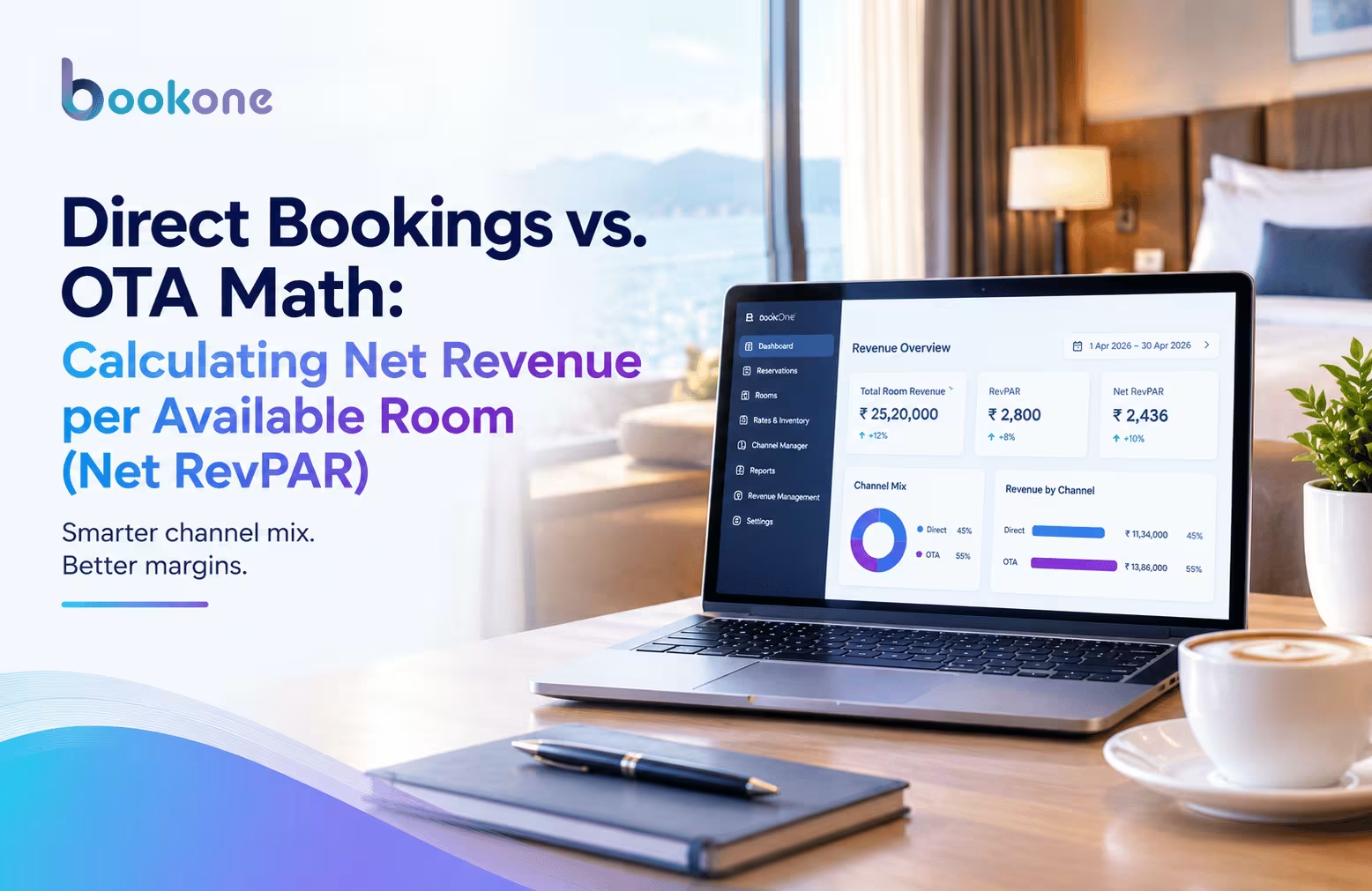
ADR and RevPAR Reporting
Track your core financial metrics through intuitive visual dashboards. Monitor your Average Daily Rate and Revenue Per Available Room on a daily, weekly, and monthly basis. Easily export these reports to share performance insights with stakeholders and property owners.
Rate Plan Optimisation
Not all booking channels yield equal profitability. VARO evaluates your active rate plans across direct bookings, corporate agreements, and various OTA channels. The system highlights which packages and platforms drive the highest net revenue, helping you curb high-commission distribution channels over time.
See how much more revenue your property can generate
Small adjustments in occupancy and pricing compound into massive increases in monthly profitability. Look at how optimizing your yield strategy changes your property's bottom line.
Metric
Traditional Manual Pricing
Optimized with BookOne VARO
Total Rooms Available
30 Rooms
30 Rooms
Average Daily Rate (ADR)
₹3,500
₹3,798
Average Occupancy Rate
65%
72%
Total Monthly Revenue
~₹20.5 Lakh
~₹24.6 Lakh
By utilizing automated dynamic pricing to improve your occupancy by just 7% and your ADR by ₹298, your property unlocks an additional ₹4.1 Lakh per month in pure revenue.
Frequently Asked Questions About BookOne VARO
Everything you need to know about AI-powered hotel revenue management.
VARO offers total operational flexibility based on your preference. You can set the system to Recommendation Mode, where it presents pricing suggestions that require a manual click to approve and push live. Alternatively, you can activate Autopilot Mode, allowing the AI to automatically update rates across your distribution network within your predefined minimum and maximum price boundaries.
Our software integrates directly with rate-shopping data engines that scan public OTA listings and brand websites continuously. You define your primary competitor set during the initial onboarding process, and VARO monitors their public pricing shifts without your team ever needing to open a browser tab.
No. We designed VARO for busy hoteliers and front office managers. The system hides complex algorithmic calculations behind a clean, intuitive dashboard. If you can read a basic chart and click an approval button, you can successfully manage your property's revenue strategy with VARO.
While having 12 to 24 months of historical booking data allows the AI to make incredibly precise seasonal predictions, it is not a strict requirement to get started. VARO can begin generating highly accurate pricing recommendations within a few weeks by leaning heavily on live market demand signals, booking pace analysis, and competitor rate tracking.
VARO delivers the highest return on investment when paired natively with BookOne PMS, as this enables instant, two-way data synchronization without lag. However, we also offer VARO as a standalone revenue management module that can connect to other major property management systems via secure API integrations.