Blogs
Housekeeping SOP Template for Small Hotels
By Admin · August 13, 2026 · 6 min read
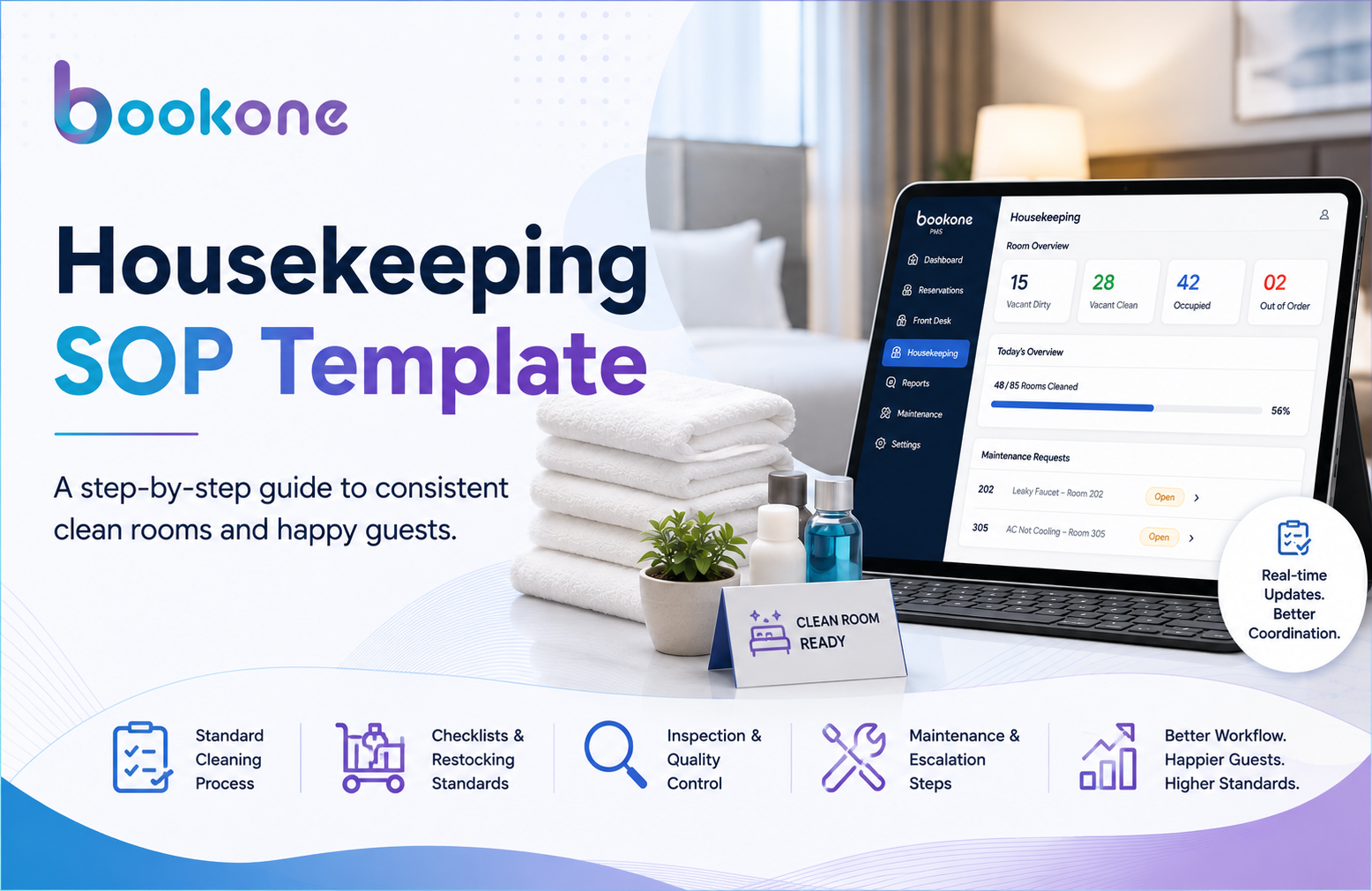
A well-defined housekeeping SOP helps small hotels deliver clean, consistent, and guest-ready rooms every time. This practical guide covers essential cleaning steps, room status definitions, restocking, inspections, maintenance escalation, and daily housekeeping workflows.
Ask five housekeeping staff at a small hotel how to clean and set up a checked-out room, and you will often get five slightly different answers. One folds the towels a certain way, another restocks the minibar last instead of first, a third skips checking under the bed because nobody told them to look there. None of this is anyone's fault. Without a written standard operating procedure, quality depends entirely on who is on shift that day, and guests notice the inconsistency even when they can't quite say why.
A housekeeping SOP fixes this by writing down, step by step, what "done" actually means for a room. It does not need to be a long manual. It needs to be specific enough that a new hire and a five-year veteran arrive at the same result.
Why Small Hotels Skip This (and Shouldn't)
Larger hotel chains build housekeeping SOPs into brand standards from day one. Independent and small hotels often rely on verbal training instead, passed from one staff member to the next, which works fine until someone leaves, a busy weekend forces a rushed handover, or you open a second property and realise the "standard" only ever existed in one person's head. A written SOP is what lets housekeeping quality survive staff turnover, not just good intentions.
Core Sections Every Housekeeping SOP Should Have
1. Room status definitions. Everyone on the team, not just housekeeping, needs the same understanding of what "vacant dirty," "vacant clean," "occupied," "out of order," and "inspected" mean, and who is authorised to change a room from one status to the next.
2. Standard cleaning sequence. A fixed order for cleaning a checked-out room, for example: strip linens and remove trash, dust from top to bottom, clean the bathroom, remake the bed, restock amenities, vacuum or sweep last, final visual check. The order matters because it prevents re-contaminating a cleaned surface or missing a step under time pressure.
3. Amenity and minibar restocking checklist. A simple list of exactly what belongs in the room and in what quantity, so restocking isn't guesswork and doesn't vary by which staff member is on duty.
4. Inspection checklist. A short list a supervisor (or the owner, in smaller properties) runs through before marking a room ready to sell: bedding, bathroom, amenities, working lights and AC, no visible maintenance issues.
5. Maintenance escalation steps. What housekeeping should do the moment they spot a broken fixture, a leak, or anything needing repair, including who to notify and how it gets logged so it doesn't get forgotten before the next guest checks in.
6. Lost and found procedure. A simple, written process for logging, storing, and following up on guest items left behind, which protects both the guest and your staff.
7. Turnaround time targets. A realistic time target per room type, so staffing levels match actual workload instead of being guessed at.
A Simple Daily Housekeeping Workflow
- Supervisor reviews today's departures, stayovers, and arrivals list at the start of the shift.
- Rooms are assigned to staff based on priority: rooms needed for early check-ins first, followed by other departures, then stayovers.
- Each room is cleaned following the standard sequence and restocked per the checklist.
- Housekeeping marks the room status as cleaned the moment it's ready, not at the end of the shift in a batch.
- A supervisor inspects a sample of rooms, and all rooms during high-occupancy or VIP arrival periods.
- Any maintenance issue is logged and escalated immediately, not held until the end of the day.
Where This Breaks Down Without the Right System
Even a well-written SOP struggles if room status isn't visible to the rest of the hotel in real time. A guest can end up assigned to a room that's still being cleaned, or a clean room can sit unsold because the front desk doesn't know it's ready. This is usually not a training problem, it's a communication gap between housekeeping and the front desk.
A property management system closes that gap by giving housekeeping and the front desk the same real-time view of room status. When a room is marked clean, it becomes sellable immediately instead of waiting for someone to walk over and confirm it verbally. This matters most exactly when your SOP matters most, during a busy check-in window with several early arrivals and a full house.
The same visibility also helps with the inspection step of your SOP. Supervisors can see which rooms are due for inspection and which have already been checked, rather than relying on a paper log that's easy to lose track of on a busy day. And when maintenance issues are logged directly against a room in the system instead of a separate notebook, nothing gets missed between housekeeping flagging an issue and it actually being fixed before the next guest checks in.
If your hotel also runs an in-house restaurant or room service, keeping housekeeping and F&B operations connected through an integrated POS means a room service tray left behind or a mini-bar charge doesn't fall through the cracks between departments either.
Keeping the SOP Alive
A housekeeping SOP is only useful if it's actually used, which means:
- Print it and post it in the housekeeping area, not just filed in a folder on someone's laptop.
- Walk new hires through a live room using the SOP itself during training, not just handing them the document to read.
- Review it quarterly, especially after adding a new room type, a new amenity, or a new service, so the SOP reflects what you actually offer today.
- Ask staff for feedback on steps that don't make sense in practice; a procedure only works long-term if the people following it believe it's accurate.
Consistent housekeeping is one of the most direct ways a small hotel builds guest trust, and it's one of the easier things to get right once it's written down instead of passed along by memory. If you'd like to see how real-time room status can take the guesswork out of your daily housekeeping workflow, you can book a demo and walk through it against your own property's room count.