Blogs
Front Desk Checklist for Indian Independent Hotels
By Admin · July 20, 2026 · 6 min read
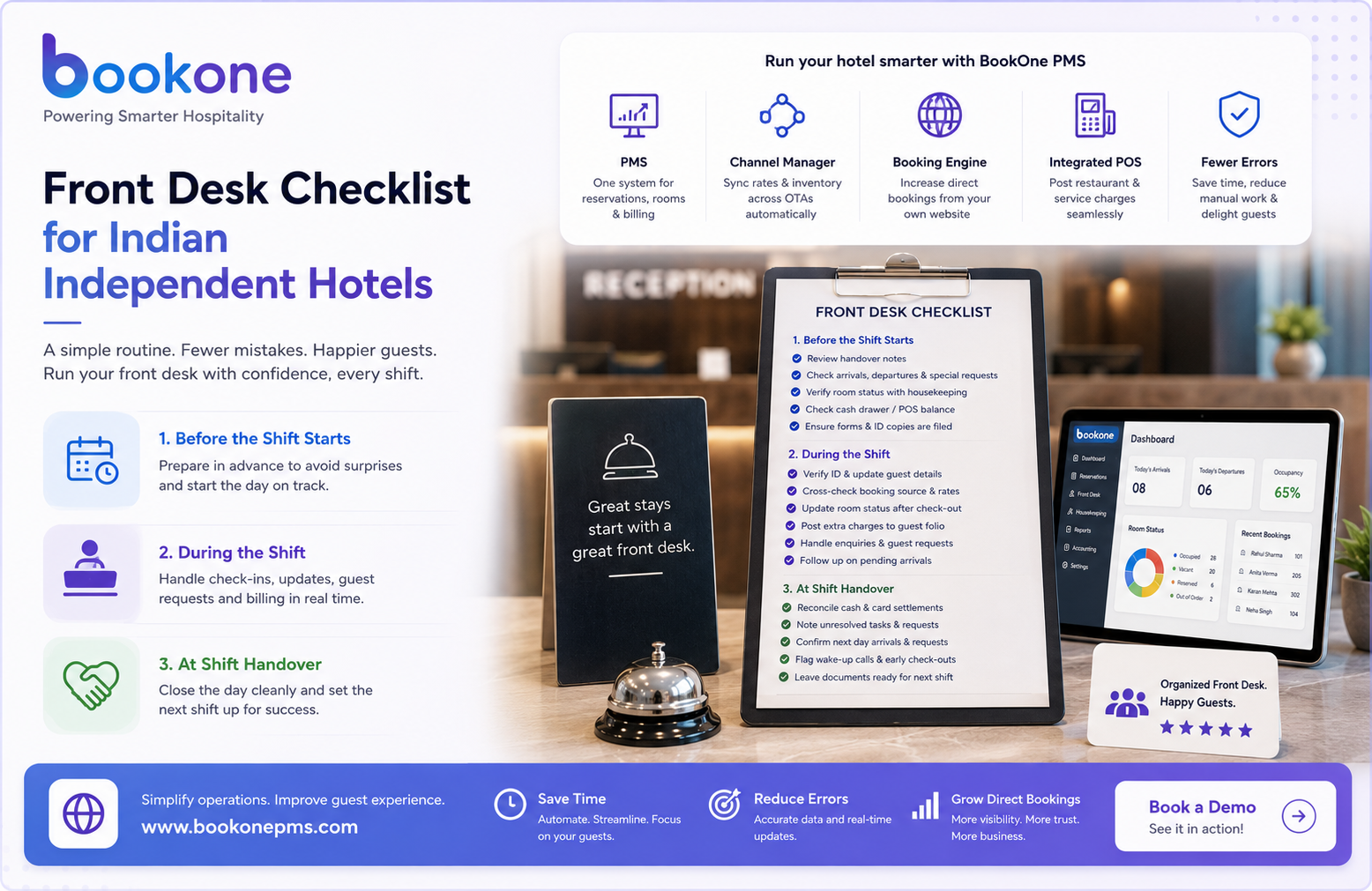
The front desk is the heart of every hotel operation, where every guest interaction shapes the overall experience. Yet for many independent hotels in India, managing check-ins, room status, billing, and guest requests manually can quickly lead to errors and delays. A simple, well-structured front desk checklist helps teams stay organized, deliver consistent service, and ensure every shift runs smoothly. In this guide, we share a practical checklist that simplifies daily operations and highlights how the right hotel technology can make these processes even more efficient.
Running the front desk of an independent hotel is a balancing act. One guest is checking out with a billing question, another is checking in early, the phone is ringing about a rate for next weekend, and somewhere in the back a housekeeping report needs to be signed off. Without a clear routine, small gaps turn into missed wake-up calls, mismatched room statuses, and guests who feel like nobody has things under control.
A written checklist fixes most of this. It does not need to be complicated. It needs to be followed every shift, by every person on the desk, whether that is the owner, a family member, or a new hire covering their first week. Below is a practical checklist broken into shift start, during the shift, and shift handover, built for the realities of a 10 to 60 room independent property in India rather than a large chain with a dedicated night audit team.
Before the Shift Starts
A few minutes of preparation at the start of a shift prevents most of the problems that show up later in the day.
- Review the previous shift's handover notes and flag anything unresolved.
- Check today's arrivals and departures list, and note any early check-ins or late check-outs already promised.
- Confirm room status against the housekeeping report so you are not selling a room that is still being cleaned.
- Check for any VIP guests, repeat guests, or special requests (extra bed, late arrival, dietary need) and prepare for them in advance.
- Verify that the cash drawer or POS terminal balance matches what was recorded at the last shift close.
- Make sure printed registration forms, Form C for foreign guests, and ID copies from the previous shift are filed, not left in a pile.
During the Shift
This is where most independent hotels lose time and money, usually to manual, repeated work rather than any single big mistake.
- Confirm ID and update guest details in the register at check-in, not after the guest has already gone to the room.
- Cross-check every reservation against the OTA or booking source before assigning a room, so a rate mismatch is caught before it becomes an argument at check-out.
- Update room status the moment a guest checks out, so housekeeping and the next booking are not working off stale information.
- Log every extra charge (room service, laundry, mini-bar) against the guest folio as it happens, not at the end of the day from memory.
- Answer phone and walk-in rate enquiries using the current day's rate, not yesterday's printed rate card.
- Note any maintenance issue reported by a guest and pass it to the right person immediately, with a rough timeline back to the guest.
- Keep an eye on same-day arrivals that haven't shown up yet, and follow up before assuming a no-show.
At Shift Handover
A clean handover is what actually makes a checklist work day after day, because it is what the next person relies on.
- Reconcile the day's cash and card settlements against the system total before closing out.
- Write down anything unresolved: a guest complaint in progress, a maintenance request, a rate exception that was approved verbally.
- Confirm the next day's expected arrivals and any special requests that need preparing in advance.
- Flag any guest who needs a wake-up call, early breakfast, or early check-out.
- Leave the register, folios, and ID documentation ready for the morning shift to review, not to reconstruct.
Why This Keeps Failing Without the Right System
Most independent hotels already know their front desk should work this way. The checklist above is not new information to an experienced hotelier. What breaks it in practice is usually one of three things: the front desk register, the OTA bookings, and the billing system all live in different places, so someone has to manually match them up under pressure; there is no single view of room status that housekeeping and the front desk both trust; and when the person running the shift changes, so does the level of discipline applied to the checklist.
This is exactly the gap a property management system is built to close. When reservations, room status, guest folios, and billing sit in one system instead of a register, a spreadsheet, and three OTA extranets, most of the checklist above stops being manual work and becomes something the system already keeps track of for you. Room status updates the moment housekeeping marks a room clean. A booking made on an OTA shows up at the front desk without anyone re-typing it. A guest's charges land on their folio automatically instead of depending on someone's memory at the end of a long shift.
The same is true for the reservation cross-checking that eats up so much time during the shift. If your rates and inventory are being managed across multiple OTAs by hand, a channel manager keeps them in sync automatically, so the front desk isn't the last line of defence against a double booking or a rate mismatch. And for the direct enquiries that come in by phone or walk-in, a well-built booking engine on your own website means fewer manual rate quotes in the first place, because the guest can already see and book the current rate themselves.
If your front desk is also handling room service or restaurant charges as part of the folio, an integrated POS removes the extra step of manually adding those charges at checkout, which is one of the more common places small billing errors creep in.
Making the Checklist Stick
A checklist only works if it survives staff turnover, busy weekends, and the person who is filling in for someone else. Three things help:
- Keep it visible. A laminated card at the desk or a pinned note in your PMS beats a document buried in a shared drive nobody opens under pressure.
- Review it monthly. Seasonal changes, a new OTA, or a new service you've started offering should show up in the checklist within weeks, not get added a year later after something goes wrong.
- Build it into training, not just handed to new staff as a document to read once. Walk a new hire through a real shift using the checklist itself.
Getting the front desk right is less about hiring more people and more about removing the manual reconciliation that eats up a shift. If you want to see what a front desk workflow looks like when reservations, room status, and billing are already talking to each other, you can book a demo and walk through it with your own property's numbers.