Blogs
From Glasgow to Hampi: How a 22-Year-Old Hotel Beat the "Silent Operational Drain"
By Admin · September 1, 2026 · 10 min read
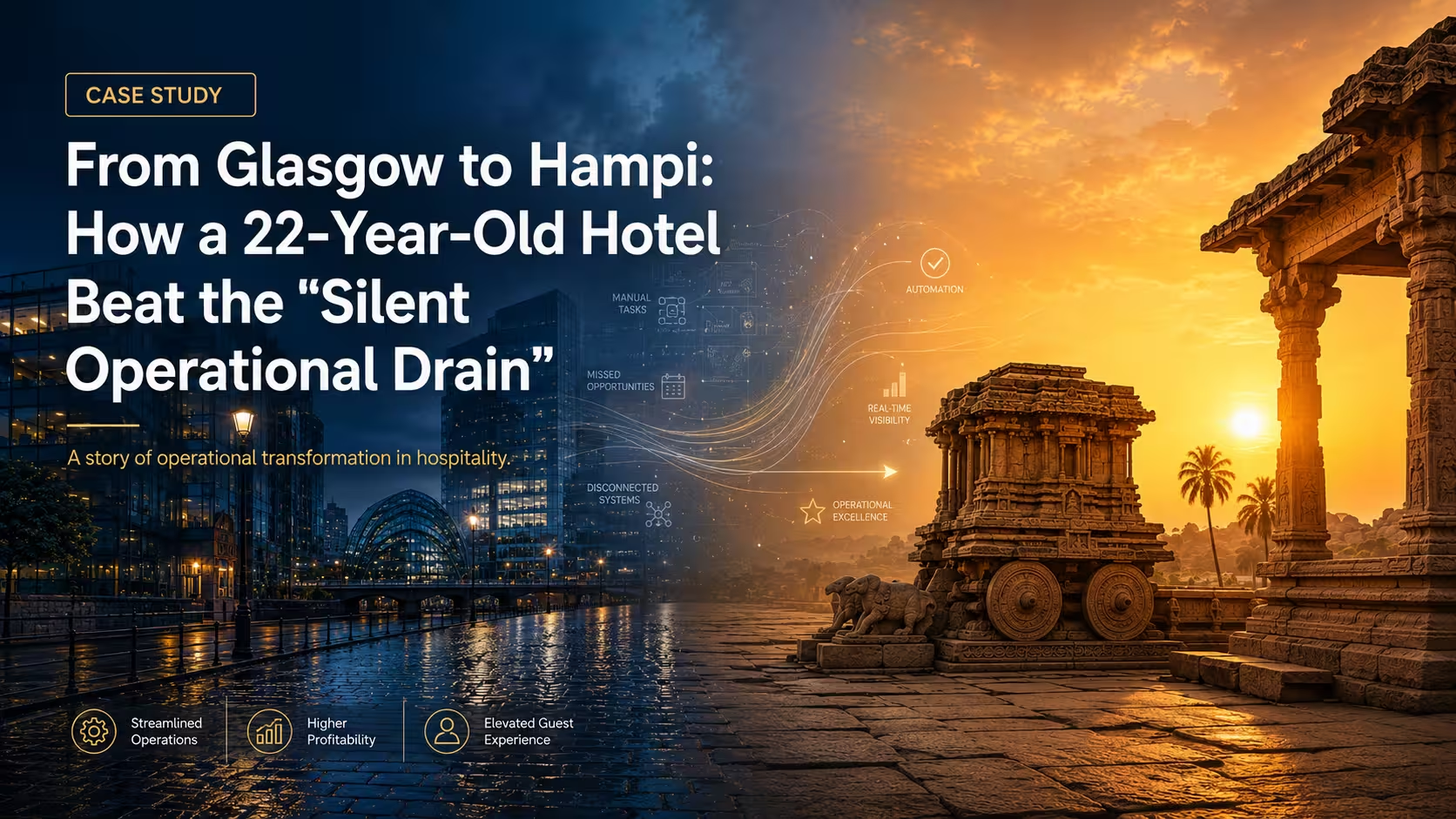
A 22-year-old, 50+ key hotel in Hosapete, Karnataka, was facing the everyday challenges of disconnected systems, manual processes, and communication gaps between departments. This case study explores how the property transformed its operations with the BookOne Hospitality Suite, connecting PMS, POS, Channel Manager, direct bookings, and WhatsApp guest engagement to create a more efficient and connected hotel operation.
A 50+ key legacy property at the gateway to a UNESCO World Heritage site had everything except a system that could keep up with it. This is the story of how it modernised — and why the hardest part had nothing to do with software.
At a Glance
| The property | 3-star, family-run, 22 years old, 50+ keys — Hosapete, Karnataka, the gateway town to Hampi |
| The problem | Frictional delays and data silos across Front Office, Housekeeping, F&B and Accounts — plus "integration fatigue" from stitching together multiple vendors |
| The catalyst | A next-generation Managing Director returning from hospitality and events work in Glasgow, Scotland |
| The solution | The BookOne Hospitality Suite — unified PMS, Booking Engine, Channel Manager, POS, Google Hotel Center partnership, Meta BSP integration and BookOne Halo (WhatsApp guest concierge) |
| The masterstroke | Removing "double work" for ground staff, then tying automated WhatsApp guest feedback to real monthly cash bonuses |
The contrast at the gateway to Hampi
To reach the ruins of Hampi, travellers pass through Hosapete. And in Hosapete, one 3-star, family-run hotel has been a pillar of regional hospitality for more than two decades.
For most of those years, traditional operations worked perfectly well. Then the pandemic reset guest expectations permanently. Weekenders from Bengaluru and international visitors alike arrived expecting instant responses, paperless convenience and contactless customisation — the kind of service that assumes a system is running quietly in the background.
The leadership knew transformation was needed. What they ran into is an industry truism that every hotelier will recognise:
Unifying data and creating transparency across departments is easy to draw on a whiteboard. It is exceptionally hard to implement on the ground.
The Silent Operational Drain
Without a single source of truth, the property was losing money and goodwill in quiet, daily increments. Nothing dramatic enough to trigger an emergency meeting — just a constant, invisible leak.
Front Office vs. Housekeeping. A guest arrives early off an overnight train. The legacy PMS still shows their room as dirty. In reality, housekeeping finished it half an hour ago — the update simply hadn't been phoned down to the desk yet. The guest waits in the lobby.
F&B vs. Accounts. Restaurant checks were physically walked to the front desk. When a guest checked out quickly, those postings arrived too late. The result was either lost revenue or an awkward billing dispute at the door.
Offline Sales vs. Revenue Management. In peak season, the offline team booked corporate groups by hand while OTA channels ran unoptimised. The property either missed the dynamic pricing surge or risked a double-booking.
Individually, each is a minor annoyance. Together, across 50+ rooms and 365 days, they are a structural drain on margin.
The catalyst: Glasgow vision meets Hampi heritage
Real digital transformation cannot be bought. It has to be led.
The turning point came when the next generation of the family took the reins. The new Managing Director had spent years running high-end hospitality and event operations in Glasgow, Scotland — a market where frictionless guest technology is a baseline expectation, not a premium feature. He came home knowing exactly what "good" felt like from the guest's side of the desk.
Then he went looking for a tech stack, and hit the bottleneck that stalls most independent hotels: integration fatigue.
Nearly every vendor promised "all-in-one." The reality was a patchwork. One had a strong PMS and a dated booking engine. Another had a capable channel manager but no CRM or billing. Assembling a working stack meant multiple monthly subscriptions, brittle API connections, and a quiet prayer that nothing would break during the 3 PM check-in rush.
The unified, cloud-based journey he had in mind looked financially and operationally out of reach — until the property found the BookOne Hospitality Suite.
Rebuilding the guest journey, not just replacing the software
Rather than swapping an offline PMS for a cloud one and calling it a migration, the hotel worked with BookOne to redesign the digital guest journey end to end.
Phase 1 — Direct discovery, without the OTA tax
As an official Google Hotel Center Partner and Meta Business Solution Provider (BSP), BookOne let the property surface real-time rates and availability directly inside Google Search and Google Maps, with a prominent Book Direct button.
High-intent organic traffic — travellers actively searching for a place to stay near Hampi — now lands on the hotel's own booking engine instead of an OTA listing. For a property in this segment, that pathway typically reclaims 15–20% of revenue otherwise surrendered to OTA commission.
Phase 2 — WhatsApp campaigns that people actually open
Indian travellers live on WhatsApp. So the hotel used BookOne's native WhatsApp automation to run targeted campaigns to past guests and warm leads — curated Hampi weekend packages, direct-booking-only rates, and seasonal offers, delivered where they'd be read within minutes rather than buried in a promotions tab.
Phase 3 — Paperless arrival, automated upsell
Every confirmed booking triggers a clean WhatsApp confirmation carrying a link to BookOne Halo, the digital guest concierge. From the Manage Booking dashboard, guests can shape their stay before they arrive:
- Pre-book a guided tour of the Hampi ruins
- Arrange a pickup from Hosapete railway station
- Pre-order in-room dining packages
The confirmation message stopped being a receipt. It became a revenue channel that runs itself.
The connected core: what "unified" actually means in daily operations
A PMS earns the word "unified" only when it acts as the single source of truth — an instant digital handshake between every department. Here's what that changed, floor by floor.
1. Front Office and Housekeeping — the end of the intercom call
The moment a housekeeper marks a room clean on their phone, the front office dashboard updates. No call, no manual round, no lobby wait. Tired travellers are checked in within seconds, and the desk assigns rooms with full confidence.
2. F&B, Room Service and Accounts — closing the checkout leak
A steward punches an order into the BookOne POS and the charge posts to the guest's master folio in real time. Whether checkout comes five minutes or five hours later, the invoice is accurate. Manual reconciliation disappears. So do billing disputes at the door.
3. Accounts and Management — from a midnight ordeal to a one-click audit
In a traditional 50-room property, the night audit is the most dreaded shift in the building. It meant three to four hours of paper-shuffling from midnight: cross-referencing cash drawers, verifying card terminals, posting room rates and GST by hand. A ₹100 discrepancy could send the auditor digging through carbon-copy F&B receipts until dawn. Worse, legacy systems froze the front desk during the audit — late arrivals were checked in on paper slips.
BookOne restructures the entire shift:
- Zero-downtime audits. Cloud architecture keeps the desk live. Late check-ins, room moves and midnight room service all process without interruption.
- Automated posting and tax calculation. Room rates and regional taxes post at a pre-set hour, in seconds, with no manual entry.
- Exception-only flagging. Instead of verifying hundreds of clean transactions, the auditor reviews only the handful the system flags.
- The morning coffee flash report. When the audit closes, BookOne compiles the day's financial, occupancy and departmental data and delivers a Daily Flash Report to the MD's mobile — ADR, RevPAR, occupancy and revenue by department, ready before his first cup.
4. Revenue and Offline Sales — one inventory, one truth
When the offline team logs a bulk corporate or event booking, those rooms block instantly across Booking.com, Agoda and MakeMyTrip. Double-bookings become structurally impossible. As availability tightens, rates lift automatically across remaining channels — so peak Hampi weekends are priced on live demand, not on yesterday's guess.
The part most tech projects get wrong
Brilliant software still fails if the people on the floor refuse to use it. This is where hotel technology projects usually die — and it deserves more attention than the feature list.
At a 22-year-old property, frontline staff had spent years perfecting manual workarounds that worked. To them, "cloud synchronisation" sounded like surveillance, extra training and more admin stacked onto an already full shift. Their resistance wasn't stubbornness. It was a rational read of past experience.
So the MD and the BookOne team built adoption on two principles: work simplification and direct incentivisation.
| Challenge | Legacy reality | The BookOne change | Human impact |
| Data entry | Registers, offline PMS, manual ledgers — the same figure written three times | Single-entry system syncing instantly across PMS, Housekeeping and F&B | Double work eliminated; staff moved from screens back to guests |
| Housekeeping | Intercom calls and physical room checks | Mobile staff portal with real-time status updates | Housekeepers gained professional ownership; the desk gained certainty |
| Motivation | Technology read as surveillance; no personal stake | Automated WhatsApp feedback tied to an incentive programme | Guest praise converts into monthly cash bonuses |
The game-changer: a feedback loop with money attached
Through BookOne Halo, an automated feedback survey reaches the guest's WhatsApp shortly after checkout. Response rates on WhatsApp are a different universe from email.
Then the hotel did the thing that made it work: it wired that feedback directly into payroll. When a guest named an employee — "Rajesh at the front desk was so helpful with our bags," "Sunita kept our room immaculately clean" — the mention was tracked. At month end, those mentions became cash bonuses and public recognition.
The shift was almost immediate. The cloud PMS stopped being a tracking tool and became a reward engine. Housekeepers turned proactive about updating room statuses, because faster room turns meant faster check-ins, happier guests, better reviews — and more money at the end of the month.
That is the whole trick. Adoption isn't won in training sessions. It's won when the system visibly makes someone's day easier or their pay better.
What "all-in-one" really means
Modernising a legacy hotel isn't a technology upgrade. It's the work of aligning human habits with digital operations, and the technology is what makes the alignment possible.
By marketing directly through Google Hotel Center and Meta, tightening the reservation loop over WhatsApp, and earning ground-floor adoption through genuine incentives, this Hosapete property didn't just adapt to the post-pandemic market. It set a regional benchmark.
For them, "all-in-one" stopped being an expensive IT ambition and became an ordinary Tuesday.
Frequently Asked Questions
- How long does migrating a legacy hotel to a cloud PMS take?
For an independent property of 50+ keys, a structured BookOne migration covers data import, channel mapping, POS configuration and staff training in phases, so the front desk never goes dark. Onboarding is guided, not self-serve. - Will my staff actually use it?
Adoption follows two things: removing duplicate work, and giving staff a personal stake in the outcome. The property in this story paired a single-entry system with a WhatsApp feedback loop tied to monthly bonuses — and resistance turned into ownership within weeks. - Can we reduce OTA commission without losing OTA visibility?
Yes. BookOne's Google Hotel Center partnership and Meta BSP integration build a direct booking channel alongside your OTA presence, while the channel manager keeps inventory synchronised across both. - What happens to the night audit?
It stops being a shift. Charges and taxes post automatically, the front desk stays live throughout, and the auditor reviews only flagged exceptions rather than every transaction.
Ready to turn your hotel's operational vision into reality?
If you're juggling disconnected systems, paying the OTA tax, or fighting ground-staff adoption, it's time to see what a genuinely unified suite looks like.
- Stop paying the OTA tax. Reclaim 15–20% of revenue through direct, commission-free bookings via Google Hotel Center and Meta.
- Erase manual double work. Enter data once; watch it sync across channels, room statuses and ledgers.
- Run operations from a phone. Housekeeping, front desk and management on live, synchronised data from any device.
- Automate upsell and protect revenue. Sell tours and dining packages on WhatsApp before arrival, and post every F&B charge instantly.