Blogs
Dynamic Pricing Basics for Independent Hotels
By Admin · November 25, 2026 · 6 min read
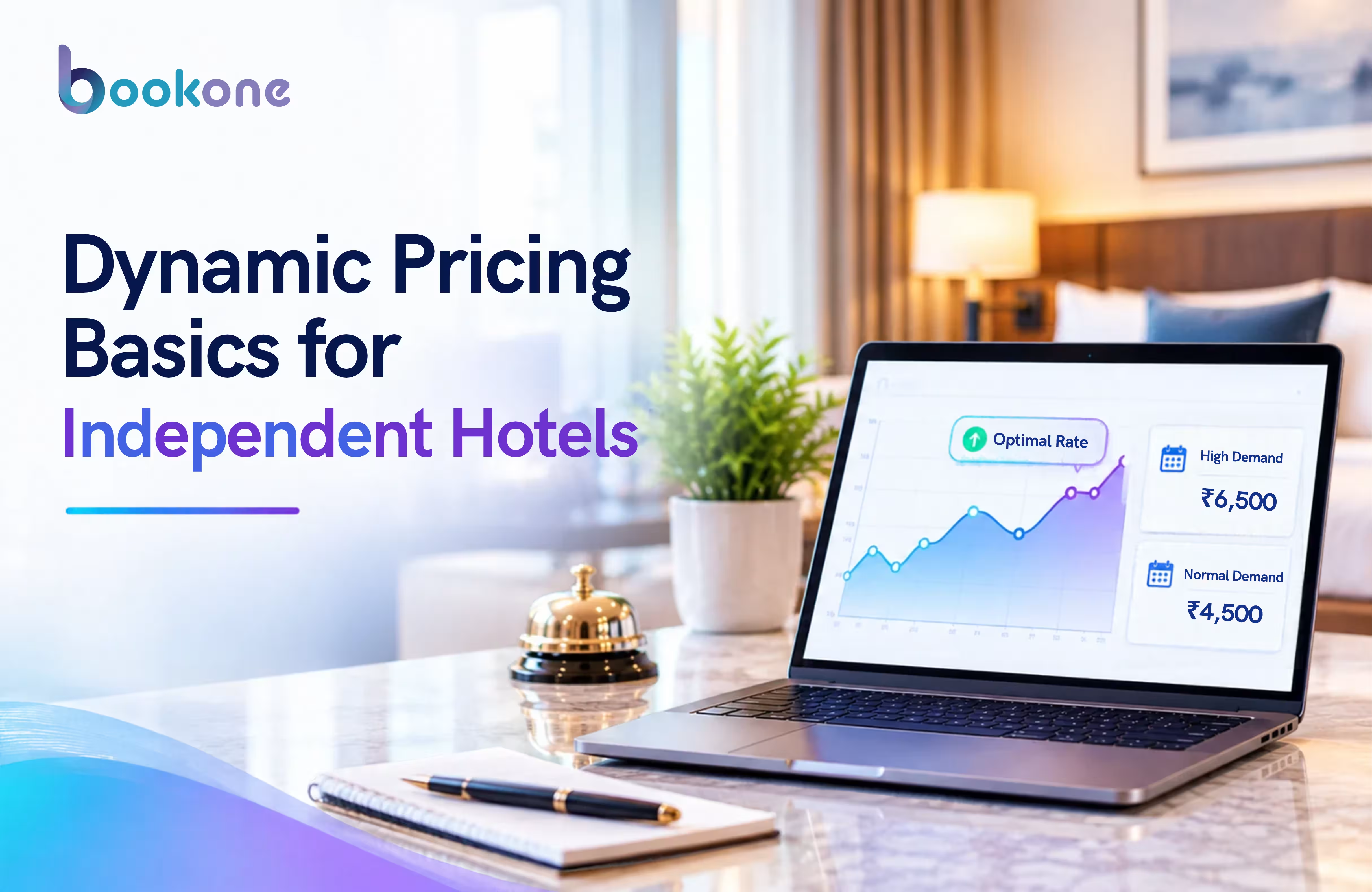
Relying on a static, printed rate card in today's fast-moving market leaves revenue on the table every single day. While fixed prices ignore real-time spikes in demand, dynamic pricing allows independent hoteliers to automatically capture the true market value of every room before it goes unsold forever.
Most independent hotels in India still run on a rate card. There is a weekday rate, a weekend rate, and maybe a higher rate for Diwali or New Year. The card gets printed, shared with the front desk, and changed once or twice a year.
The trouble is that demand does not follow a printed card. A cricket match, a wedding in town, a sudden spell of rain or a long weekend can change how many people want your rooms, sometimes within a day. Dynamic pricing is the habit of letting your rates respond to that demand instead of ignoring it.
This guide explains the basics in plain language, so you can start small without buying anything new.
What Dynamic Pricing Actually Means
Dynamic pricing means changing your room rate based on how much demand there is and how many rooms you still have left to sell. When demand is strong and rooms are filling, the rate goes up. When demand is weak and rooms are sitting empty, the rate comes down or you add an offer.
It is not about charging as much as possible. It is about selling each room at the best price the market will pay on that date. Airlines and cinemas have done this for years. Hotels are well suited to it because a room that goes unsold tonight can never be sold again.
What Drives the Right Rate
A good rate looks at several signals together:
- Occupancy on the books. How full are you for that date, compared with the same point last year?
- How far away the date is. Rooms booked months ahead and rooms booked the day before behave differently.
- Day of the week and season. Business hotels and leisure hotels have very different weekly patterns.
- Local events. Festivals, weddings, exams, conferences, matches and fairs.
- Competitor rates. What similar hotels near you are charging for the same dates.
- Your own costs and floor rate. The lowest price you can accept once commission and costs are covered.
You do not need all of these on day one. Even two or three, used consistently, put you ahead of a fixed rate card.
Dynamic Pricing in Four Simple Rules
1. Set a floor and a ceiling. Decide the lowest and highest rate for each room type. Prices move inside this range, which keeps you safe from panic discounts and from pricing yourself out of the market.
2. Raise rates as rooms sell. A simple version is to set a few price levels and move up a level when you hit certain occupancy points. For example, if a date is half sold two weeks ahead, move it up one level.
3. Lower rates carefully when demand is slow. Before cutting the rate on every channel, try a targeted offer on your own website, a longer stay discount or an add-on such as breakfast. A rate cut that appears on every OTA is hard to reverse.
4. Review often, not constantly. Check the next 30 days every week, and the next 7 days every day. Checking all 365 days every morning is a recipe for burnout.
A Simple Example
These numbers are only for illustration, so replace them with your own.
Say you run a 25-room hotel with a base rate of ₹3,200. You set three price levels for a regular weekend:
| Occupancy already booked | Rate per night |
| Under 40 percent | ₹3,200 |
| 40 to 70 percent | ₹3,800 |
| Over 70 percent | ₹4,500 |
Fifteen days before a weekend, you are at 45 percent, so you move to ₹3,800. A week later you cross 70 percent, so you move to ₹4,500. The last few rooms sell at the highest price, which is the point of the exercise.
Now compare it with a fixed rate. If 5 of those 25 rooms would have sold at ₹4,500 but you sold them at ₹3,200, you gave away ₹6,500 for one night. Over a busy season, that adds up.
Common Mistakes to Avoid
- Changing rates on one channel only. Guests compare prices. If your website says ₹4,500 and an OTA still shows ₹3,200, you have lost the direct booking and the margin. Our post on OTA parity explains how rates drift apart.
- Discounting too early. Cutting the rate months ahead tells the market your hotel is cheap. Wait until you can see how the date is actually filling.
- Ignoring commission. A higher rate sold through an OTA can earn less than a lower rate sold directly. Look at what you keep, not what you charge. Our guide to Net RevPAR shows how to work this out.
- Using the same rule for every day. A Tuesday in the monsoon and a wedding Saturday need different rules.
- Forgetting the minimum stay. On busy dates, a one-night booking can block a better multi-night one.
- Never looking back. Review each month which dates sold out too early and which did not sell.
Doing This by Hand vs. With Software
You can start with a spreadsheet and a weekly review. For a small hotel with a few room types, that is a good first step.
It gets harder as you add OTAs, room types and rate plans. Every price change has to reach every channel, and one missed update can sell a peak room at the wrong rate. A channel manager sends your new rates and availability to all your OTAs at once, and a booking engine on your own website shows guests the same current price. Your PMS keeps the room inventory behind all of it accurate.
The next step is a revenue management system, which reads demand signals for you and suggests rates, so you are not guessing from a spreadsheet. That is the time saver for a busy owner.
If your main challenge is a specific season, our guide to festive and wedding season pricing shows how to build a rate plan before the rush.
How to Start This Week
- Pick your three most important room types.
- Write a floor rate and a ceiling rate for each.
- Set three price levels between them, tied to occupancy.
- Check your next 30 days once a week and move dates up or down a level.
- Make sure every change reaches your website and every OTA the same day.
- At the end of the month, note which dates sold early and which sold late.
Dynamic pricing is a habit more than a technology. Start with a simple ladder, review it weekly, and add tools as your property grows. If you would like to see how rate management, channel sync and demand-based pricing work together for a property like yours, you can book a demo and we will walk through it with your own room count.